COVID-19 FAQ’s
We’ve had alot of questions about assistance for businesses affected by Covid-19, so we are starting to compile them.
If you have any questions please feel free to email us at hello@optimisedaccounting.com.au

We’ve had alot of questions about assistance for businesses affected by Covid-19, so we are starting to compile them.
If you have any questions please feel free to email us at hello@optimisedaccounting.com.au
What is the new JobKeeper payment?
We have created a video here. This covers:
Do Sole Traders & Self Employed people receive the new JobKeeper payment?
The good news here is that sole traders and other self-employed individuals are eligible for this payment, with the 30% turnover reduction rule still applying.
At this stage, the treasury documents state that non-employing businesses need to nominate an individual to receive the payment. We are awaiting clarity to see how this will work with partnerships and trusts where multiple partners/beneficiaries actively work within the business.
Who is an eligible employer for JobKeeper?
An eligible employer is a business whose turnover has dropped by more than 30% compared to the same period a year ago. (For companies with a turnover of over $1b the reduction must be 50%)
Who is an eligible employee for JobKeeper?
How do I pay the JobKeeper payment to my employees?
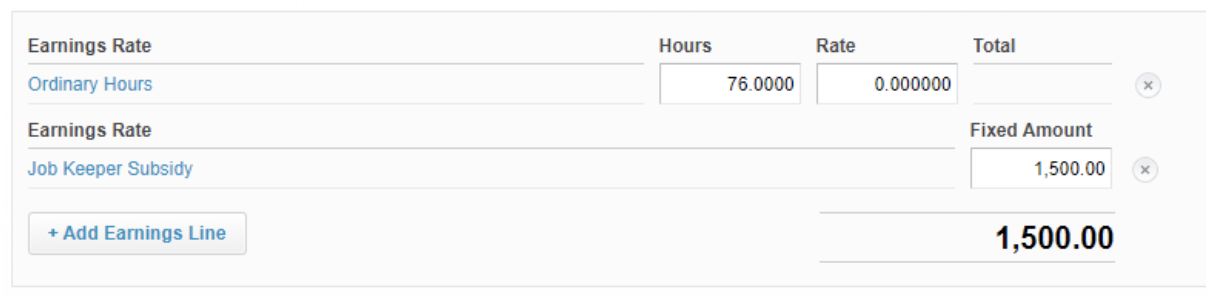
These amounts are paid to employees through your usual payroll cycle.
If an employee usually earns > $1,500/fortnight before tax
Nothing changes in the way you pay the employee – it’s business as usual.
If an employee is earning under $1,500/fortnight before tax
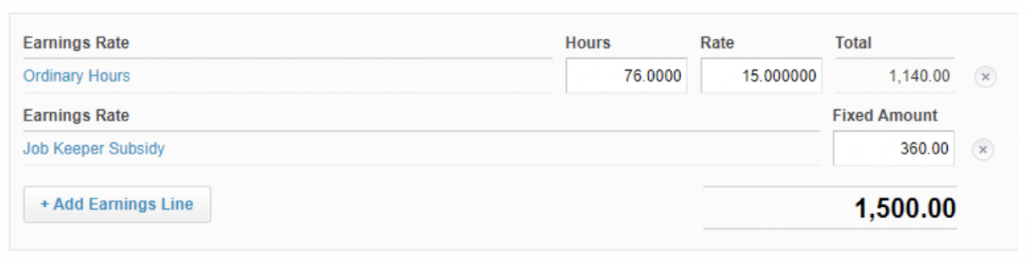
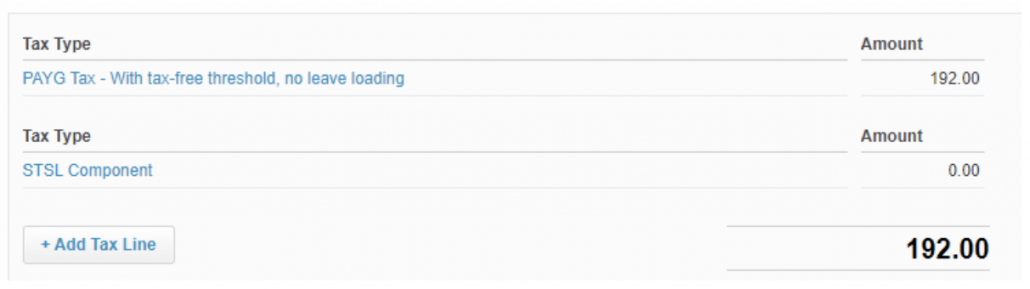
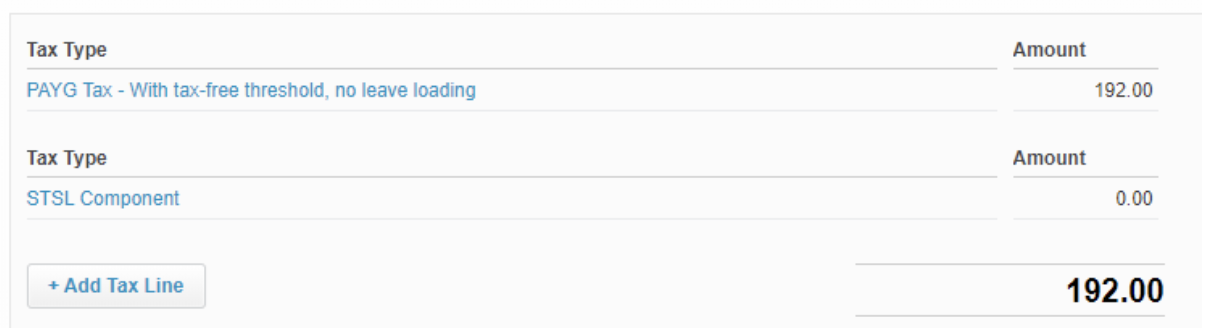
You will need to ‘top up’ their earnings to $1,500 and withhold tax from the full amount.
Superannuation is optional on any top up amount only – which is the additional amount being paid to an employee above of their ordinary earnings to bring the payment up to the $1,500.
When do registrations open for JobKeeper?
Monday 20th April 2020 – They are open now!
When do I get paid from the ATO?
Payments will arrive from the ATO monthly in arrears – JobKeeper payments that you pay to your staff in April will be reimbursed to you in the first week of May. This means that the business must have sufficient cashflow/cash reserves to make the regular payroll payments as well as any top-up amounts.
What about the employees that I’ve already stood down?
If an employee was eligible and was active with you on 1 March 2020, they can be ‘re-hired’ and paid the full JobKeeper payment. The benefit of doing this is you can keep a relationship with the stood down employee, which will allow you to make them productive again as soon as you are able to open.
Should the employment with an employee end at any time during the six month period, you will no longer be eligible to receive the JobKeeper payments for this employee and the ATO will need to be notified.
Does the business and the employee pay tax on the subsidy?
Yes – this payment is taxable to both the employer and the employee.
On the employer side, the employer will recognise the wage subsidy as revenue and the salary payment to the employee as a deduction.
On the employee side, the wage subsidy will add to your taxable income from which your employer withholds tax.
When do I need to register by (if I think I’m eligible for April)?
This date has been extended to 31st May.
Any top-up payments to staff are due 8th May.
Do I need to put all of my employees on JobKeeper?
Yes.
If an employer decides to put one of their eligible employees on JobKeeper, they have to put all of them on.
How do I engage Optimised Accounting to register JobKeeper for me?
We can take care of JobKeeper for you.
Things this service includes:
• Review your figures to advise which test is best for you.
• Review your turnover forecast and assumptions with you.
• Review your employee data spreadsheet to determine employee eligibility.
• Register for JobKeeper on your behalf.
• Monthly review of employee wages to ensure maximum correct claim.
• Provide ATO with monthly turnover and projected turnover figures.
• Provide assistance and support on the JobKeeper scheme.
How do I register for JobKeeper myself?
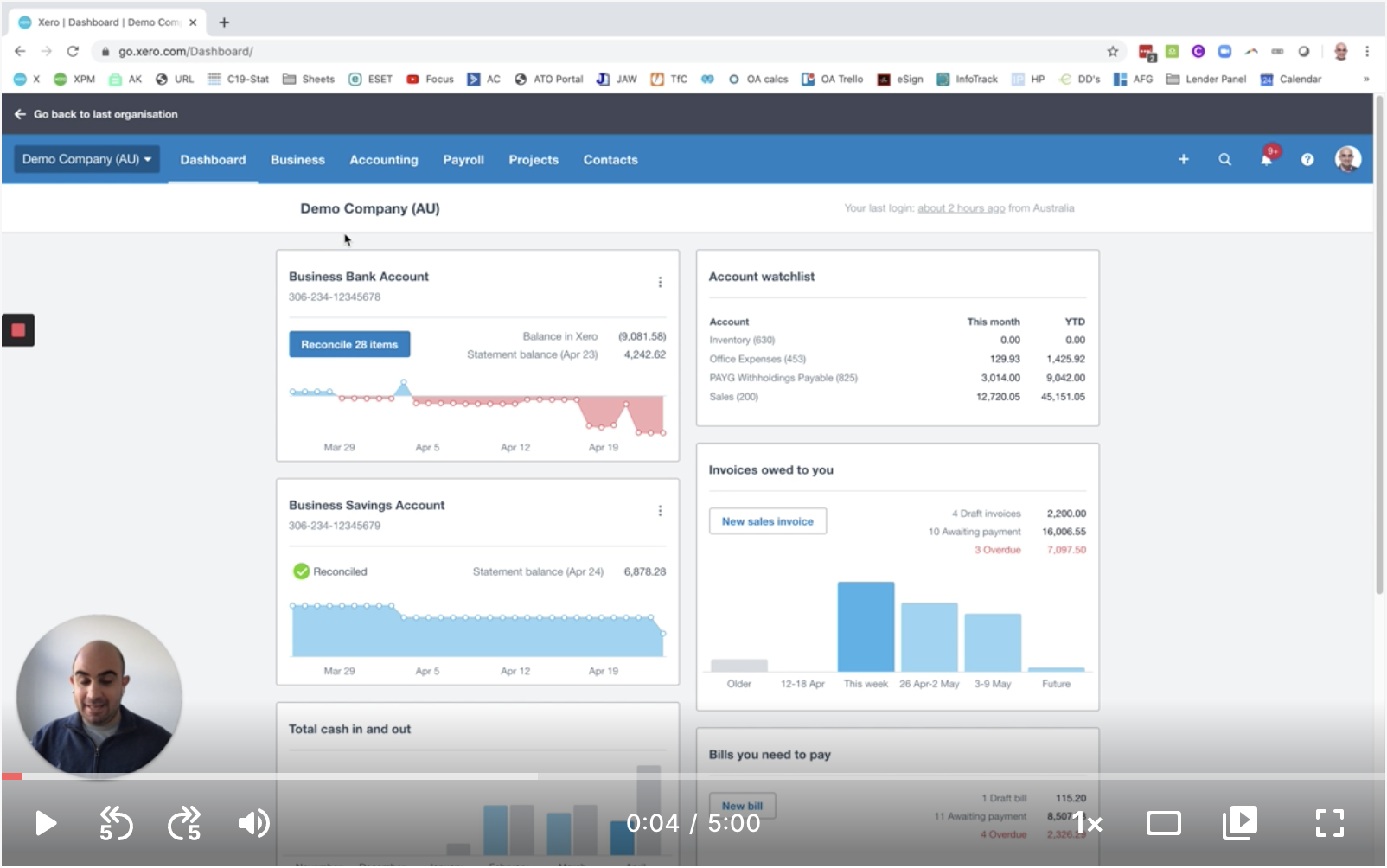
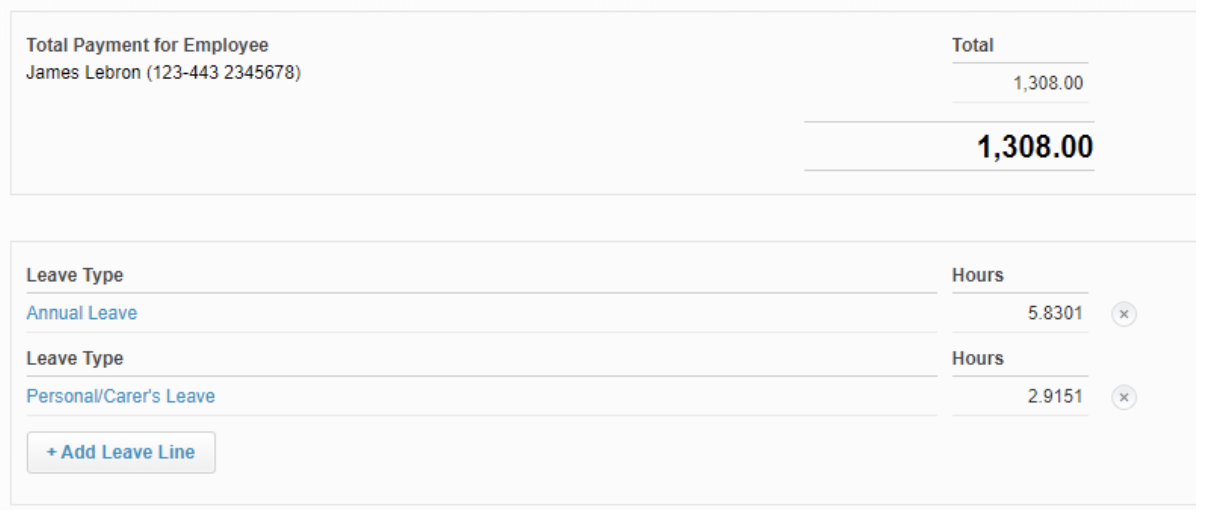
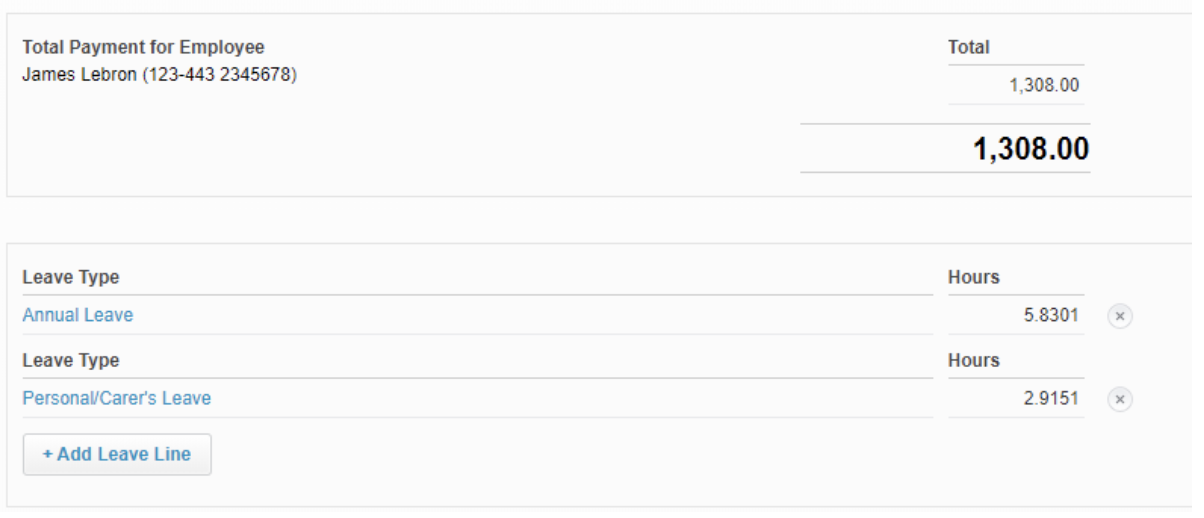
How do I pay out JobKeeper through payroll in Xero?
We have recorded a walkthrough with Xero explaining how to pay your employees in Xero.
Watch it here:


Where can I find the JobKeeper Employee nomination form?
Where can I find the Letter Confirmation to Employee of JobKeeper nomination?
Where can I find the Employee Eligibility Matrix?
You can download this here.
What are the ATO published JobKeeper pay cycles?
Do I have to pay JobKeeper according to the published fortnight pay cycles?
Can a 16–17 year old student qualify for JobKeeper?
If they are a full time student, who is NOT classed as financially independent, no.
If they are a full time student, who IS classed as financially independent, yes.
Will the JobKeeper income be treated as taxable income? In other words, should we be putting a portion aside from the payments for income tax to be payable?
Yes, it’s taxable income
Does our revenue need to stay below 30%?
Whilst we need to report revenue each month to the ATO, it will not change your eligibility.
Once you are eligible for JobKeeper payments, you are eligible for the entire time (til end September 2020).
Are JobKeeper top-ups exempt from payroll tax?
Yes.
Any additional payments that an employer makes to bridge the gap between their employee’s normal wage and the $1500 a fortnight required to qualify for JobKeeper payments are now exempt from payroll tax.
For employees who have been stood down, the full $1500 payment is exempt.
How do I reconcile my JobKeeper payment?
We have created a ‘JobKeeper’ account code in your chart of accounts.
Simply hit ok!

How long will JobKeeper go on for?
At this stage JobKeeper is in place for 6 months (till end September 2020).
However, the government and ATO may change the length of time JobKeeper is available for employers.
What is the deadline for JobKeeper monthly reporting?
14th day after the end of the month (e.g., 14 June deadline for May).
The Commissioner has granted a deferral for the requirement to lodge the monthly declaration to the ATO for JobKeeper purposes. The ATO has extended the deadline from the 7th day after the end of the month to the 14th day after the end of the month (e.g., 14 June deadline for May).
However, the ATO has indicated that JobKeeper payments will be made depending on the time this declaration is lodged. That is, the earlier this step is completed from the 1st day of each month the earlier businesses will receive their payments for the JobKeeper fortnights for that month.
More Information
Why do I need to do JobKeeper reporting?
Monthly JobKeeper reporting doesn’t affect your eligibility, it is for statistics purposes for the ATO.
JobKeeper & Termination payments
An employment termination payments (ETP) is a lump sum payment made to an employee when their job is terminated. ETP’s are generally made up of unused sick leave or unused rostered days off, payment in lieu of leave, genuine redundancy payments, etc.
For some employers, JobKeeper will not be enough to keep the employee employed. If you do need to let staff go, the ATO has stated that from JobKeeper fortnights from 8 June onwards until the end of the scheme, ETPs cannot be included as part of the $1,500 an employer needs to pay to eligible employees to access JobKeeper payments.
If any JobKeeper payments include an ETP to a terminated employee between 30 March to 7 June, the ATO has stated that it will not recover an overpayment.
How do I register my intent to claim for JobSeeker (Newstart allowance)?
We have created a short walk through MyGov below:
I can’t afford to pay my BAS this quarter, should I lodge anyway?
Even if you are not eligible for the Cash Flow Boost, the ATO has also advised that they are offering tailored support on a case by case basis if you or your business has been affected by Covid. Some of the measures they have outlined as potential assistance are things like remittance of interest and penalties, low interest payment plans, changing the GST reporting cycle (if you are due GST refunds you can potentially move to monthly reporting to get quicker access to your refund), and payment deferrals.
If your lodgements are up to date you will be in a good position to discuss these possibilities with the ATO so keep up with your lodgements, and we can work with you and the ATO regarding payment if you have been affected by Covid.
When do the payments commence for the PAYG cashflow boost?
28th April
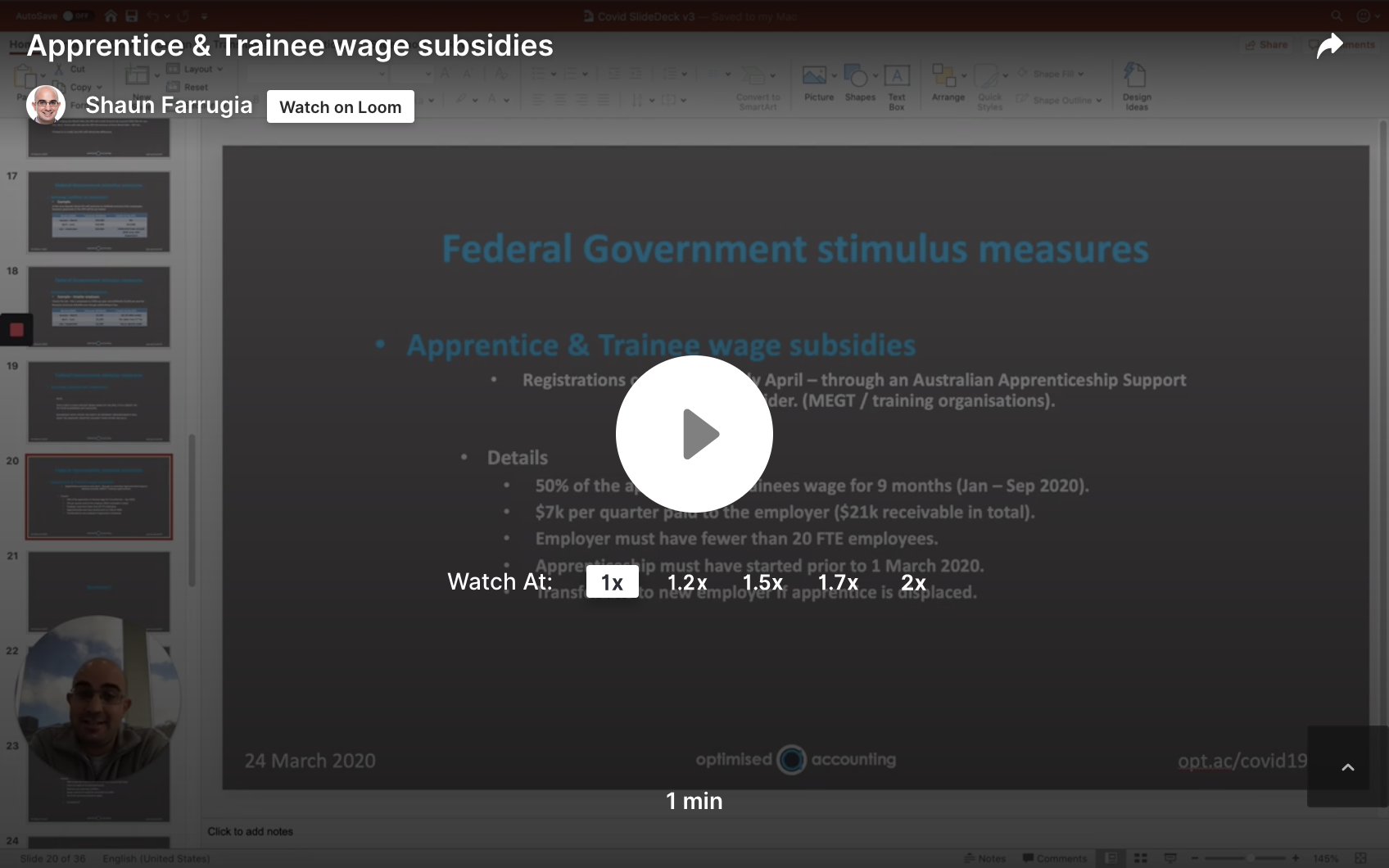
Apprentice & Trainee subsidy – What do I get and how can I get it?
Transferable to new employer if apprentice is displaced.
What is the eligibility criteria for early access to my Superannuation?
To apply for early release, applicants must satisfy any one or more of the following requirements:
To gain access to this, you need to register your intention to withdraw Super with MyGov. A link to view this can be found in question 3 (below)
How do I register my Intention to redraw my super?
We have created a walk through in MyGov.
Watch below (from 3 minutes in):
Do I still need to pay my staff their Super on time?
Short answer, yes.
The ATO will still issue penalties for any late payments of employees super, even by one day.
Superannuation is due on 28th April.
I can’t afford to pay my BAS this quarter, should I lodge anyway?
Even if you are not eligible for the Cash Flow Boost, the ATO has also advised that they are offering tailored support on a case by case basis if you or your business has been affected by Covid. Some of the measures they have outlined as potential assistance are things like remittance of interest and penalties, low interest payment plans, changing the GST reporting cycle (if you are due GST refunds you can potentially move to monthly reporting to get quicker access to your refund), and payment deferrals.
If your lodgements are up to date you will be in a good position to discuss these possibilities with the ATO so keep up with your lodgements, and we can work with you and the ATO regarding payment if you have been affected by Covid.
What is the Business Support Grant?
A $10K grant from the government, for Victorian businesses.
The government have extended the eligibility for the ‘Business Support Grant’ to include JobKeeper eligible businesses who employ staff. You need to have a turnover above $75K, with a payroll below $650K.
When do I need to apply by?
1st June 2020
Will Optimised Accounting do this for me?
If we applied for JobKeeper for you, yes we will do this for you if we think you are eligible.
How much is the instant asset write-off?
$150K
What are the rules about a tax write off for a sole trader for cars?
When does the instant asset write off finish?
This was due to end with the EOFY however has been extended to 31st December 2020.
How much is this grant?
Is it tax free?
Yes
Who will be distributing this?
The revenue office of the State or Territory where you live or plan to live.
What is the individual eligibility?
To be eligible you need to be:
And, you need to meet the income test. To be eligible, you cannot earn more than:
What is the building project eligibility?
The building contract must be signed between 4 June 2020 and 31 December 2020. And, the construction or renovation must commence within three months of the contract date.
How much is this grant?
How do I apply?
What type of businesses can apply for this grant?
(this is the original criteria, from August this may change. We’ll update when we know)
Businesses can apply where they meet all the criteria listed below. They must:
Businesses that have received funding from other components of the Victorian Government’s Economic Survival Package are eligible to apply for this program.
Business owners that do not employ people (non-employing businesses) are not eligible for funding through this program.
When does this grant close?
Applications for the program close on 14 September 2020.
I already applied for this grant, do I need to apply again for the additional $5K
No.
The additional $5K should come through automatically.
If my business is no longer eligible, what do I need to do?
Make sure you keep all of your records relating to JobKeeper including your calculations and rationale for the decline in turnover test, your employee JobKeeper nomination forms, and any other records for at least five years.
What are the turnover tests?
30 March to 27 September 2020
Projected GST turnover for a relevant month or quarter is expected to fall by at least 30% compared to the same period in 2019.*
28 September to 3 January 2021
Actual GST turnover in the June and September 2020 quarters fell by at least 30% compared to the same periods in 2019. The decline for both of the quarters needs to be met to continue receiving JobKeeper payments.
4 January 2021 to 28 March 2021
Actual GST turnover in the June, September and December 2020 quarters fell by at least 30% compared to the same periods in 2019. The decline for all three of the quarters needs to be met to continue receiving JobKeeper payments.
* Alternative tests potentially apply where a business fails the basic test and does not have a relevant comparison period.
What are the payments?
28 September to 3 January 2021
4 January 2021 to 28 March 2021
How long will JobKeeper 2.0 run for?
From 28th September until 28 March 2021
What are the fortnights?
(28 September 2020–17 January 2021)
High rate: $1,200
Low rate: $750
(4 January 2021–28 March 2021)
High rate: $1,000
Low rate: $650
What’s the 10% decline in turnover test?
The 10% decline in turnover test is a test that enables employers previously participating in JobKeeper to continue to use the JobKeeper provisions (with some modifications) under the Fair Work Act. These employers are ‘legacy employers’. This test does not impact on your business’s eligibility to receive JobKeeper payments, it only impacts on an employer’s use of the JobKeeper provisions under the Fair Work Act.
If an employer qualifies under the 10% test, they can:
Employers can continue to utilise the JobKeeper provisions if they:
To meet the turnover test, a legacy employer needs to demonstrate at least a 10% decline in actual GST turnover for the quarter in 2020, when compared to the same quarter in 2019. See Legacy employers on the Fair Work Ombudsman’s website.
Is my business eligible from 28th September?
Existing JobKeeper participants need to pass the extended decline in turnover test to continue to receive JobKeeper payments on behalf of employees. This extended test looks at your actual GST turnover for the September 2020 quarter (for JobKeeper payments between 28 September to 3 January 2021), and again for the December 2020 quarter (for payments between 4 January 2021 to 28 March 2021).
To pass the extended decline in turnover test, your business will need to show an actual decline in turnover between the September 2020 quarter (July, August, September 2020), and the same period in 2019 by 30% (15% for ACNC registered charities and 50% for large businesses).
My business has not received JobKeeper previously. Can we get it now?
If your business passes the eligibility criteria, you can access JobKeeper when you need it for your eligible employees. For JobKeeper, your business needs to pass the eligibility tests for the period you are seeking to claim JobKeeper payments.
My business can’t pass the decline in turnover test because we were impacted by a natural disaster/drought in 2019
Special rules exist to ensure that businesses trading (or partially trading) in a region impacted by natural disasters or drought in 2019 are not detrimentally impacted when calculating the decline in turnover tests. Assuming the drought or disaster impacted your GST turnover, the alternative test enables you to use a period in the year immediately preceding the year in which the drought or natural disaster was declared for the decline in turnover test comparison. This is, if your business was impacted by drought/disaster in the September quarter of 2019, you can use the September quarter of 2018 for your comparison period. If 2018 was also a drought/disaster zone, you can keep going back until the first year preceding the declaration of drought/disaster.
To use this test, your region must be subject to a formal declaration of drought or disaster (for example from Government) or have been publicly identified by an agency such as the Bureau of Meteorology.
My business fails the test because its turnover is ‘lumpy’
If your business has ‘lumpy’ or irregular turnover, there is an alternative decline in turnover test that you might be able to apply. This test only applies if your GST turnover is irregular, like what often occurs in the building and construction industry, and not simply a seasonal variation. To understand if your turnover is irregular, look at the 12 months before the test period and divide the 12 months into 3 month periods. If the lowest GST turnover for any of these 3 month periods is no more than 50% of the highest of the 3 month periods, then the test can be applied as long as your business’s turnover is not cyclical. Alternatively, you can look at the 12 months before 1 March 2020 instead of the 12 months immediately before the test period.
If your GST turnover is irregular you can compare your current GST turnover for the test period with the average current GST turnover for the 12 months immediately before the applicable test period or 1 March 2020, multiplied by 3.
My business is a new business without a 2019 comparison period. Can it receive JobKeeper payments?
If the business is a new business that started trading after 1 March 2020, the business will not be eligible for JobKeeper payments (although there are special rules for not-for-profit or registered charities in some circumstances).
If your business started trading before 1 March 2020 but after 1 July 2020, there are alternative tests you can use to determine whether your business is eligible for JobKeeper payments from 28 September 2020:
What happens if a business restructure (or sale or acquisition) impacts on your numbers?
An alternative decline in turnover test is available where there has been a disposal or acquisition of part of the business, or restructure in the business, or combinations of those, and this changed the entity’s current GST turnover.
The alternative test compares the GST turnover for the test period with the current GST turnover for the relevant month immediately after the disposal, acquisition or restructure, multiplied by 3. If there is not a whole month after the last acquisition, disposal or restructure, and before the turnover test period, then the month immediately before the turnover test period is used.
Where there have been multiple disposals, acquisitions or restructures, you can use the whole month immediately after any of the disposals, acquisitions or restructures, multiplied by 3 for the alternative test.
What happens if fast pre COVID-19 growth makes the comparison period unrealistic?
If your business was experiencing strong growth before the pandemic hit, your comparison period numbers can be skewed. This alternative test is for entities with substantial pre COVID-19 growth. First you need to test if your growth is considered substantial. That is, GST turnover increased by:
If there is substantial growth and you used the period immediately before the turnover test period to determine whether there is a substantial increase in turnover, then the alternative test compares GST turnover for the test period (for example, the September 2020 quarter) with turnover for the 3 months immediately before the test period.
If you are using the period immediately before 1 March 2020 to determine whether there is a substantial increase in turnover, then the alternative test compares GST turnover for the test period (for example, the September 2020 quarter) with turnover for the 3 months immediately before 1 March 2020.
I am a sole trader (or partnership) impacted by illness, injury or leave
For sole traders and small partnerships (4 partners or fewer) with no staff, your income is often impacted by your ability to work. If your comparison period is impacted by illness, injury or leave, you can use the month immediately before the month with sickness, injury or leave is used, then multiplied by 3.
Does the business need to re-enrol?
Your business does not need to re-enrol if it is already receiving JobKeeper payments. Employers continuing to receive JobKeeper payments will need to:
Make sure you keep records of your calculations for the decline in turnover test, and the JobKeeper payment tiers for employees.
What happens if the employee’s hours were different to normal in the reference period?
Alternative tests are available where:
What happens if the employee’s salary is not linked to hours?
Some employees will automatically qualify for the higher JobKeeper payment rate. To qualify for the higher rate, these employees: were paid at least $1,500 in the reference period; were required to work at least 80 hours under an industrial award, enterprise agreement or contract; or, it is reasonable to assume that they worked at least 80 hours during the applicable period.
What about directors and partners in a partnership?
Business participants (sole traders, the self-employed with an ABN, or one partner in a partnership, beneficiary of a trust, or director/shareholder), must use the month of February 2020 (the whole 29 days) as their test period. The test looks at the number of hours you were actively engaged in the business – actively operating the business or undertaking specific tasks in business development and planning, regulatory compliance or similar activities.
Other than sole traders, a business participant must provide a declaration to the business entity confirming their hours worked over the reference period. Sole traders need confirm details with the ATO.
Where February 2020 was not typical, you can use the next typical 29 day period, or if you commenced during February, March 2020.
My employer is no longer eligible for JobKeeper. Can I receive JobKeeper from another employer?
Employees and business participants can normally only have one nominated employer for the JobKeeper scheme (ever). If your nominated employer is no longer eligible for JobKeeper payments, you cannot be a nominated employee of another employer. The main exception to this is where the individual ceased to be employed or actively engaged in the business (as a business participant) of the original entity after 1 March 2020 but before 1 July 2020. They must also have met the conditions to be treated as an eligible employee of the new employer at 1 July 2020.
How much is this grant?
$2,000
Who can apply for this grant?
To be eligible, you must:
What do I need to do to apply for this grant?
When applying for this grant you will need:
Please make sure your ABN registration information and, where required, ASIC registration, or relevant regulator information, is current.
Incomplete or incorrect information may delay your application assessment. Please complete the application correctly and provide all relevant documentation.
How do I apply?
The program will be open for applications until the date the program funds are exhausted or 11:59 pm on 16 March 2021, whichever is earlier.
When does this grant close?
The program will be open for applications until the date the program funds are exhausted or 11:59 pm on 16 March 2021, whichever is earlier.




 5 tips for working remotely (productively)